Systems and Portraits
When we look at Manet’s “A Bar at the Folies Bergére”, why don’t we see the viewer reflected in the painted mirror? It is from this question that I have become interested in a painting’s ability to convey and distort multiple realities. I am interested in a kind of imagery that is involved with framing experience. The narratives in my work incorporate the viewer and their space as an extension of the space inside the painting. I do this by depicting spatial loops and using parallel mirrors, and infinite wallpapers with variable systems.
Paintings are an extension of reality because every mark describes something about the person who made it, and every mirror reflects the person viewing it. My paintings are usually portraits of my friends whose identities have been transformed to fit formal conventions, and my past experiences and interests. I consider the stuff in my paintings to be a framework for an interchange between a self-portrait and a portrait of the viewer. Among the references in my paintings are the transitional colors of the Rococo sunset, the toxic slime of late 80s cartoons, and the schizophrenia of a messy desktop. I want my paintings to show an exaggerated obsession with work and information that reflects on contemporary life.
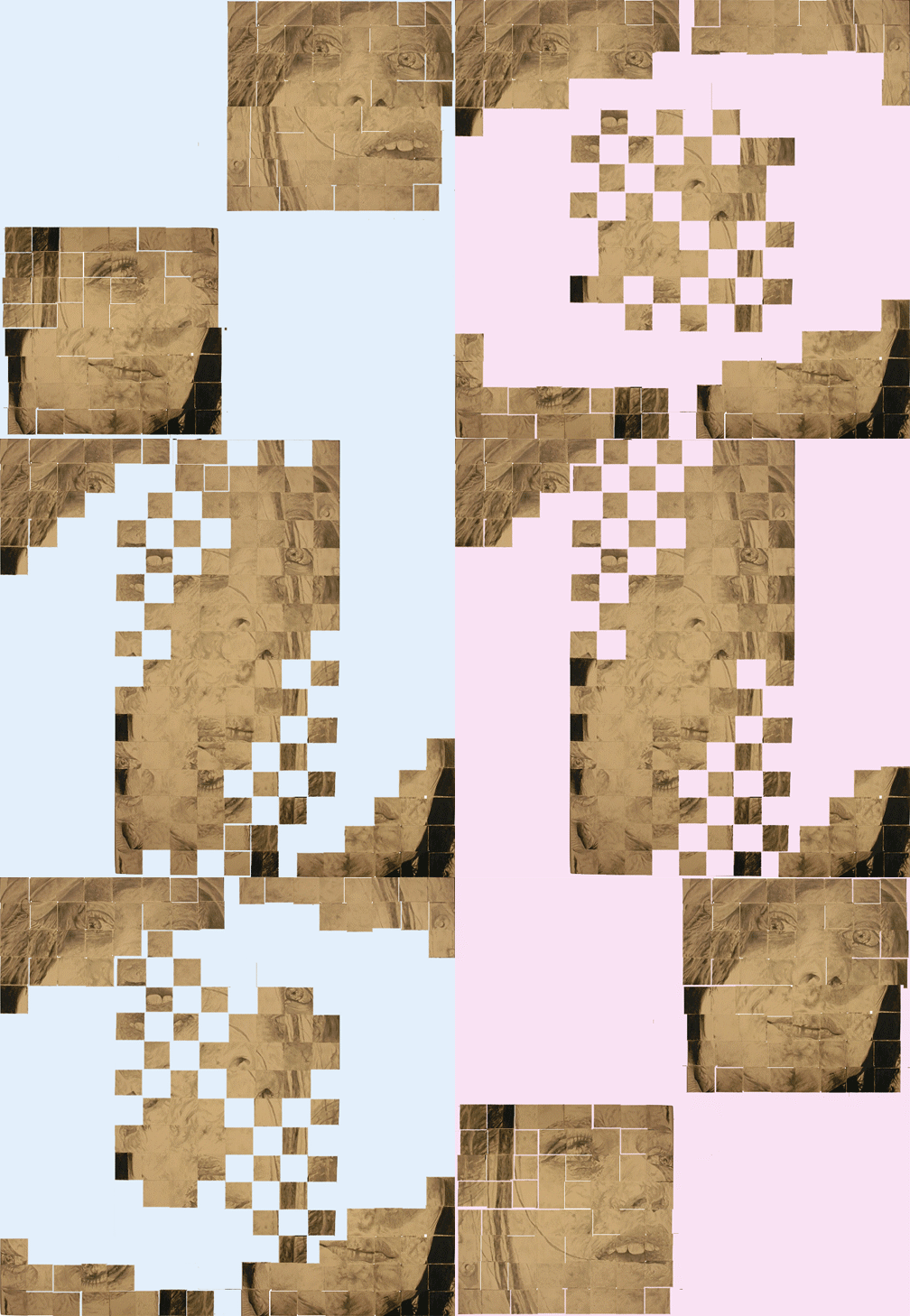
2007-2011 Statement
My work has evolved out of my need to correct what seems to be a flaw in Photorealism as it was originally validated as a process-based form of Conceptualism. It was the act of transcribing photographic information through paint onto a canvas, yet the large, obsessively detailed images emphasized the painting as an illusion and not a process. I show the grid and emphasize the mark-making process within its increments to reveal the painting process, after all the process and materials are real, and not a photographic illusion. I've incorporated space and stripes as measurements into my paintings to further emphasize the painting as a real object.
Taking the real one step further, I have related the subjects of my work to my perception of the images and discourse that describe Art History and the Internet. The portraits that I paint allow for me to relate ideas and are only the product of my experience. Therefore, they more accurately depict what I believe to be the essence of painting, which is self-reference. My paintings are about my thought process as I create fictional characters through the relationship of stylistic devices.
My portraits are about creating single identities. They reveal a sense of isolation that comes with specialization and a distortion of the real through simulations such as Facebook. As the objectives of my painting are to find what is real and true, the subject matter of my work has become an exaggerated unreality of constructed identity.
